
Reimagining Adam and Eve
A Playful Exploration of Timeless Art
Art has always been a space where stories are told, retold, and imagined in new ways. Today, I’m sharing a piece that surprised and amused me in ways I didn't expect. The idea began with a simple question: what if the great masters of art had created their iconic works as children? With this playful concept in mind, I set out to see how innocence and simplicity might reshape well-known artistic narratives, and, well, I got more than I bargained for.
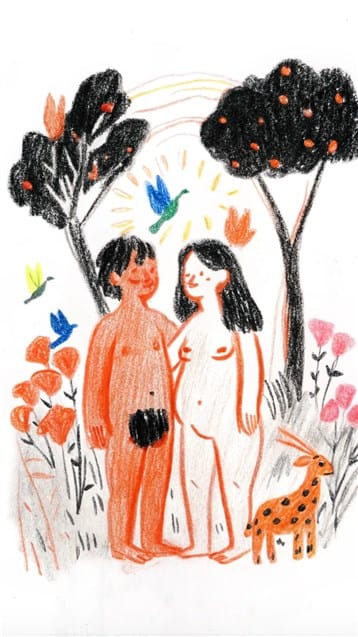
This particular artwork, titled The Garden of Eden, is my rather unexpected reinterpretation of the first panel of Hieronymus Bosch's renowned triptych, The Garden of Earthly Delights. Bosch's original panel portrays the serenity of Eden, the creation of Adam and Eve, and the harmony of a world untouched by corruption. Inspired by this timeless theme, I decided to reimagine it as though it had been painted by a child—complete with all the innocence (and surprising bluntness) that such a perspective might bring, like the exaggerated and unashamed depiction of Adam and Eve's nudity, which felt both raw and endearing.
In this version, Adam and Eve stand side by side, their nudity depicted with the kind of straightforwardness that only a child could muster. It was both funny and surprising to see how this playful approach handled such an iconic scene. Around them, vibrant natural elements abound. Dark foliage with bright orange fruits contrasts with colorful flowers. Birds in shades of blue, green, and orange flit joyfully through the scene, while a small, spotted creature adds a whimsical touch. The bold lines and cheerful colors evoke a sense of simplicity and wonder—qualities often associated with a child’s perspective—and perhaps an unintentionally hilarious take on innocence.
Embracing the Unexpected
While this piece may not represent the final direction of my project, it stands as an example of what can happen when we let ourselves play, embrace the unplanned, and view the world through a lens of curiosity. Sometimes art surprises us in the best ways, and it doesn’t always need to be serious or complex to tell a meaningful story. This playful reinterpretation of Adam and Eve is a perfect example of how simplicity and humor can add new layers of meaning to a well-known narrative.
Join the Conversation
I invite you to explore this reimagined Adam and Eve and reflect on how simplicity, humor, and creativity can transform even the most familiar tales. Let me know what emotions or memories this piece sparks for you—I’d love to hear your thoughts.


Member discussion