From Concepts to Canvas: The Odyssey of My Mini Prints
When I began this journey, it wasn't about making sales or building a business empire. It was about discovery—exploring creative possibilities and embracing the learning process. Of course, as an artist, there's a part of me that dreams of seeing my work displayed in homes across the globe. But honestly, that's not my main motivation. For me, the heart of this journey lies in the act of creation itself, in seeing an idea grow and take shape in ways I couldn't have imagined.
From Experiments to Focus
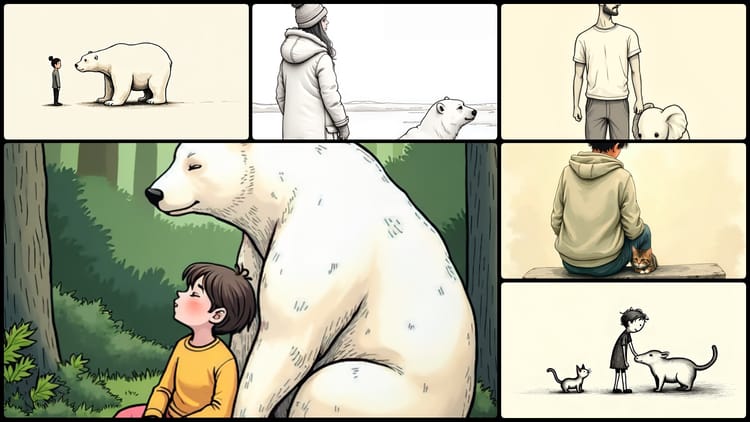
After diving deep into the world of AI-generated images, I quickly found myself with an overwhelming collection—more than 3,500 creations in just a year. Creating these pieces was exhilarating, but after a while, I began to wonder: what could I actually do with all of this digital art? The fun was undeniable, but I felt an itch to give these creations a tangible purpose.
At the same time, I noticed the rise of influencers selling customized t-shirts and mugs, shouting promises of "Get Rich Quick" through AI-driven "print-on-demand" products. I can't deny that the allure of easy money was tempting. For a brief moment, I even imagined what it would be like: quitting my day job, leisurely sipping coffee while orders poured in, the numbers climbing effortlessly. But deep down, I knew this picture wasn't quite real. Production challenges and endless marketing efforts—it all sounded like too much hustle for something that wasn’t truly me. Yet, despite my skepticism, this whole movement planted a seed in my mind.
What if I could create products that truly represented my art? Not for quick profit, but for something that felt meaningful. Something that resonated. So, I brainstormed. I imagined different ways to turn my digital work into something you could touch and feel. Posters, canvas prints, even tote bags—I experimented with them all, trying to bring my vision to life in a form that others could cherish. There was magic in each format, but also hurdles, particularly when it came to production and shipping. Competing on price was almost impossible, especially with the high shipping costs in Canada. It soon became clear that I needed to find another way.
The Shift to Mini Prints
During a brainstorming session with ChatGPT, the idea of mini-prints came to light—5x7 format prints, to be precise. It was a lightbulb moment. This format was easy to produce locally, cost-effective, and available with a quick turnaround (sometimes even same-day). That was essential for me. Without a huge budget, producing items in bulk wasn’t realistic, and the idea of quick, small-batch production was perfect to avoid sitting on unsold stock. It provided flexibility and felt right.
My exploration into AI tools continued, and I discovered their remarkable ability to analyze and understand images. I found this incredibly helpful for describing my creations and writing product listings on Etsy. It became almost a game—refining my prompts to see just how deeply AI could dive into the nuances of an image. That’s when a new idea struck me: what if these images were part of a story? What if there were a narrative, a piece of text that could bring out the emotional core of the image? Could the viewer connect it to a scene from a favorite book or a feeling they once had?
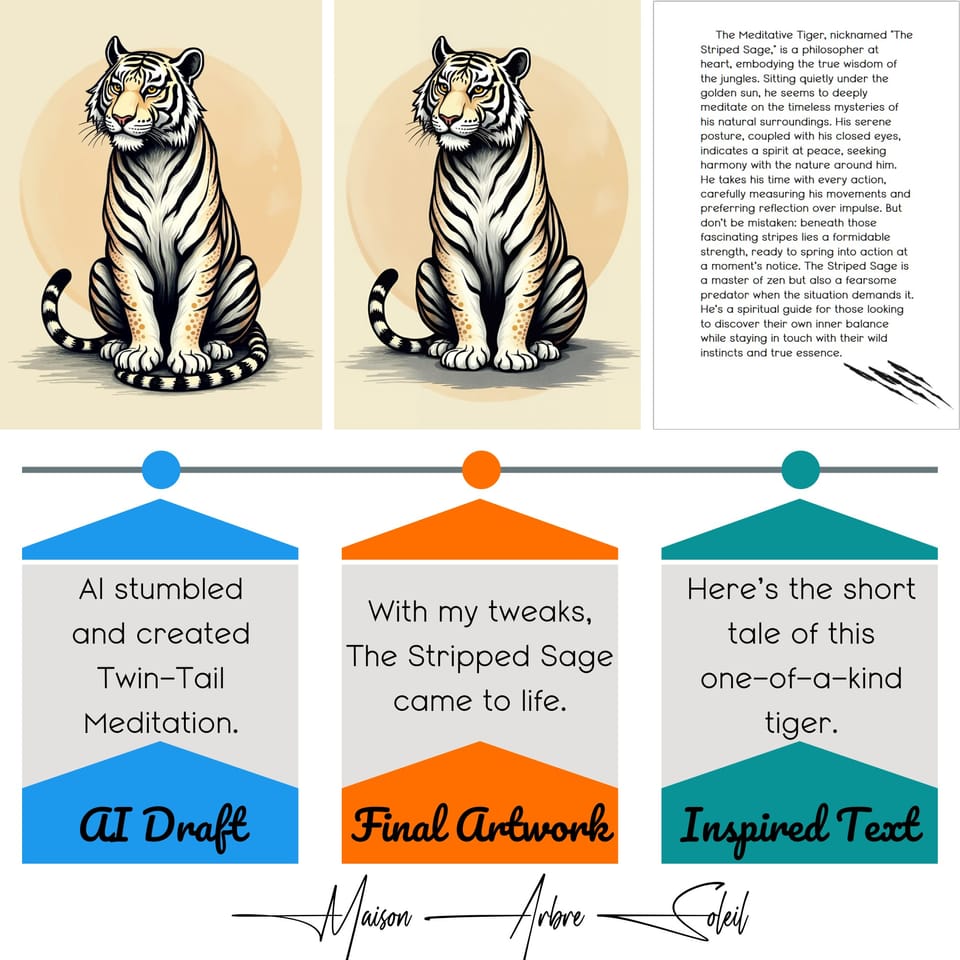
Obviously, using literary excerpts was out of the question due to copyright concerns, so I fed my ideas to the AI and asked it to create something new—something inspired by the images themselves. Before I knew it, I realized I had something quite unique: mini prints with evocative, original texts that complemented the visuals. It felt like I’d found the heartbeat of my creative process.
Image Selection With AI Tools
Initially, I tried to follow the typical flow of "idea → experimentation → image → finished product," but it didn't really work for me. I think part of the problem was my struggle to fully master generative tools and get them to produce exactly what I envisioned.
So instead, I decided to let go of rigid expectations during my creative sessions. I allowed myself to be spontaneous—to create images without worrying too much about how they would be used. I experimented, tried new styles, different prompts, and explored various generative AIs, just following my curiosity. When something resonated, when an image had potential, I’d explore it further, create variations, refine it, and see where it could go. It was less about perfection and more about staying open to the magic of the process.
To keep track of the many AI-generated images I was creating, I turned to Excire Foto, a photo management software that helps me stay organized. It makes navigating my growing library easy and allows me to quickly find specific images when I need them. Its AI-powered search tools help me locate the right creations for each project—whether for a mini print or just for inspiration—keeping me in control of my workflow without feeling overwhelmed by the sheer volume.
The AI-generated images often need some polish before they match my vision, and that's where my editing toolkit comes in. I use several applications that help me bring each piece to life:
- Luminar Neo is my go-to for adjusting colors, contrast, and lighting. It also lets me add or remove elements as needed. It’s flexible and helps me refine images to get them closer to what I imagine.
- Affinity Photo 2 is my backup when Luminar Neo doesn’t quite fit the task. It offers more precision for complex edits, like fine-tuning layers and masks or perfecting compositions. When I need meticulous adjustments, it’s the tool I reach for.
- Aiarty Image Enhancer is invaluable for upscaling resolution. Without it, many of my images wouldn’t be up to the quality standards I need for printing. Aiarty helps ensure my work is sharp, clear, and ready for high-quality prints.
Crafting the Text: A Creative Process
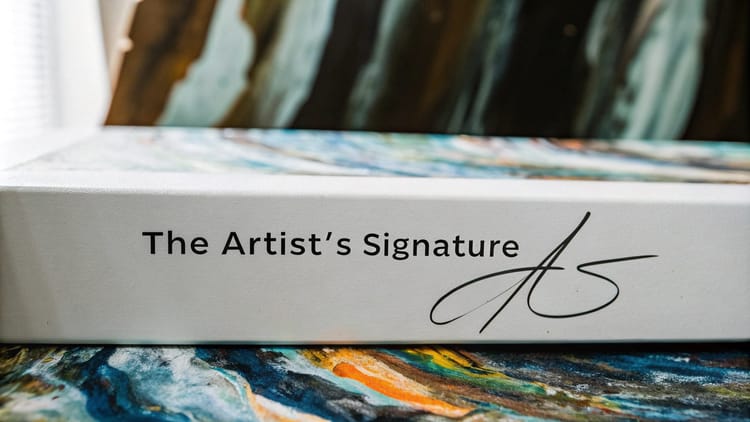
Of course, the visual is only part of the story. The accompanying text on the back of each mini print adds that special touch—it brings the image to life in a new way. Working with ChatGPT, I experiment with different narrative directions until the right one clicks. It’s a bit like a dance, a creative conversation. I’ll suggest something, ChatGPT will respond, and we go back and forth. I ask for changes, sometimes I get frustrated when it doesn’t count characters or words correctly, but eventually, we land on the perfect narrative that fits the image like a glove.
Reflecting on the Process
I understand that generative AI can be controversial. Some might say that I’m not a “real” artist because it’s not my hand creating each shape or color on a blank canvas. But to me, AI is just another tool—no different from a brush or a camera. It’s about how you use it. The raw AI-generated image is only a starting point, and it’s my job to perfect it, to add my own touch and make it something meaningful.
The same goes for the texts. I’m not naturally gifted when it comes to expressing my thoughts in beautiful, evocative words, especially since I’m a French-speaking Québécois, far from fluent in English. AI helps me articulate emotions that might otherwise stay buried, giving them a voice.
Throughout this entire process, I’ve had the chance to learn so much. It’s that spirit of discovery that keeps me going. I love learning new techniques, figuring out new tools, and challenging myself to do better. Every time I experiment, it keeps my creativity alive and makes the journey worthwhile. Whether these mini prints end up in homes or remain cherished only by me, the process itself has been incredibly rewarding. Every step, from the initial idea to the final product, has been a learning experience, and that’s what this journey is really about—growing, adapting, and always pushing myself to see what’s possible.
Member discussion